
|
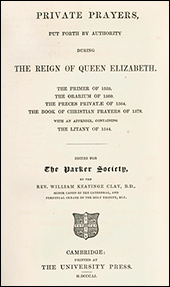

"Private Prayers,
put forth by authority during
The Reign of Queen Elizabeth"
Edited For The Parker Society
By William Keatinge Clay
Hail & Fire REPRINTS
(work is underway)
|
CONTENTS:
THE PREFACE. THE PRIMER OF 1559. THE ORARIUM OF 1560. THE PRECES PRIVATÆ OF 1564. THE BOOK OF CHRISTIAN PRAYERS OF 1578. APPENDIX: THE LITANY OF 1544. |
THE PRIMER.
Of English Protestant Primers we may consider, that there were two series, the one originating with Henry the Eighth, in 1545, the other with Edward the Sixth, in 1553. Henry's Primer was several times reprinted, not only in his own reign, but in that of his son. The latter reprints, however, ought rather to be called improved editions, since by the alterations successively made in them (which were for the most part doctrinal) they shewed the steady advancement of the Reformation, together with the gradual purification of the religious opinions held by our leading Protestant divines. In 1547 [1] Edward's first Primer (British Museum) came out, printed 'at London, the laste daie of Nouember,' and, like almost all the copies of the earlier series now existing, by Grafton. This was a mere republication of the Primer of 1545, men not being
yet prepared, we may suppose, to alter what had been so recently and on such high authority established. Two years later Grafton sent forth another Primer (Library of Emmanuel College, Cambridge), which was likewise a mere republication of its predecessor, with the exception of one particular, but that a most important one. The Litany of 1545 (see p. 51, note 5) had three invocations addressed to the Virgin Mary, to holy Angels, &c. and to Patriarchs, &c. These were now, in 1549, omitted, as they had previously been omitted from the Litany introduced into the first edition of the Prayer-Book published only a few months before. Let it also be mentioned in connexion with this subject, that, at the end of the same year, or early in 1550 (3 and 4 Edward VI.), an act passed 'for the abolishinge and puttinge awaye of diuerse Bookes and Images,' in which there was the following clause: 'Prouyded alwaye, and be it enacted by thauctoritie aforesaide, that any person or persons maye vse kepe haue and reteyne any Prymers in the Englishe or Lattyne tongue set forthe by the late Kinge of famous memorie Kinge Henrie theight; so that the sentences of Invocation or Prayer to Sainctes in the same prymers be blotted or clerelye put out of the same.'
[1] Fuller, ignorant, assuredly, of the existence of the Primer of 1545, for his list does not contain it, informs us (Book vn. p. 385), that the Primer of 1547 was translated out of Henry's Orarium.
From this period we perceive a very great improvement in the English Primer, as to its doctrinal tone; so that, when again published in 1551 (British Museum), it contained neither the angelic salutation, 'Hail, Mary, full of grace,' &c. with various passages, indicative of an unabated reverence for the Virgin, nor some of the other objectionable things, which appeared in the Primer of 1545. In fact, great modifications then took place, strong as many of the doctrinal statements are, which were still permitted for a time to remain. As regards the angelic salutation, and its retention in 1547 and 1549, it seems right to extract a passage from Marshall's Primer (University Library, Cambridge, G. 3. 39): 'Here thou seist that in these: wordes no petition, but pure prayses and honours are conteyned: lyke as in the begynnyng and fyrste wordes of the Paternoster is no petition, but onely prayse, and declarynge of the godly fauour and maiestie, that he is our father, and in heuen. Therfore we can not call this salutation a petition, or any prayer, properly and strayghtly to speake therof, bicause it is not laufull for vs to expounde these wordes further than they sounde, and than the holy ghoste dyd make them.' Moreover, it will not be amiss to quote from that treatise, which Ludovicus Lavaterus published at Zurich in the beginning of 1559, entitled De ritibus et institutis ecclesice Tigurince. Under the head Sacrce conciones et preces occurs this passage: Salutatio angelica ad certum usque tempus ab initio recitata fuit. Sed, oblata occasione, et postulante necessitate, coepit prætermitti; cum non sit oratio, et a multis in abusum trahatur. Satis autem constat melioribus illis temporibus, antequam divi invocarentur, locum inter preces non habuisse.
A fourth impression of the Primer (to confine ourselves to Edward's reign) was published in 1552 both by Grafton and Whitchurch. This Primer has not been met with, and is, therefore, known to the Editor only from its title, as quoted by Herbert in his edition of Ames, pp. 534, 548 [2].
The title, however, contains two peculiarities; for it is, 'The primer and catechisme sette furthe by the kynges highnes, and his clergie, to be taught learned and redde of all his louing subiectes, al other set apart, corrected according to the statute made in the thirde and .iiii. yeare of our soueraigne lordes the kynges maiesties reigne.' Except as to the Catechism, it was, most probably, a verbal reprint of the Primer of 1551.
[2] No copy of the edition of 1552 is noted down in Mr Dickinson's list of printed Service Books, put out in 1850. Fuller (Book vii. p. 385) has it.
With 1553 commenced the second series of Primers referred to before. Edward's licence to William Seres, who was thenceforward to be the royal printer for this description of books, is dated the sixth of March; and by it he is granted the privilege of printing 'all manner of books of private prayers, called and usually taken and reputed for Primers, which are and shall be set forth agreeable and according to the book of common prayers established by us in our high court of Parliament.' The Primer of 1553 varies, consequently, in many essential points from its predecessors, so as to be altogether of a quite different character. Like that of 1552, it has the Catechism; but it has not, under the head of Graces, the Lord's Prayer, the Creed, and the Ten Commandments: the Hymns
too are left out; the Hours of Prayer, the Dirige, the Commendations, &c., with every thing touching upon either prayers for the dead, or the efficacy of the Saints' prayers. Indeed, it is simply a book of private prayers for each day in the week, beginning with Sunday, in some small degree after the ancient model, followed by the Collects for Sundays and Holy Days throughout all the year, with sundry Godly Prayers for divers purposes. There is one singular circumstance connected with the Primer of 1553. Immediately after the Graces comes a 'preparative unto prayer,' and then this sentence, - 'And in thy faithful prayers remember [3] Thomas Cottesforde the preparer of this preparative.' Liturgies of K. Edward VI. p. 377.
... more Preface to come.
[3] In the reprints of 1560 and 1568, which will be mentioned in due course, it is: 'remember to praye for Elysabethe our most gracious Quene.'
THE PRIMER OF 1559.
... content to come.
THE ORARIUM OF 1560.
... content to come.
THE PRECES PRIVATÆ OF 1564.
... content to come.
A BOOK OF CHRISTIAN PRAYERS
Collected out of the ancient writers, and the best learned of our times (1534).
... content to come.
To the Christian Reader zeal and knowledge in true and hearty prayer through Christ Jesus.
DAVID, a prophet and a prince, to whom the Lord had done many, great, and singular, benefits, bethought himself not so much to increase them by use, as to requite them by thanks. He, therefore, willing as a prophet, and able as a prince, but not able in deed, though willing so to do, opened his good heart ... more To the Christian Reader (Richard Daye) to come.
PRAYERS:
A Prayer to be said both Morning and Evening.
Prayer for the Church, and all the states thereof (by John Foxe).
A Prayer for the Queen's Majesty.
... full list of Prayers to come.
APPENDIX: THE LITANY OF 1544.
... content to come
Copyright ©
 HAIL and FIRE
www.hailandfire.com